


Slewing Bearings
Product Overview
Slewing bearings transmit axial loads, radial loads, and overturning moments simultaneously through a single mounting arrangement. Built with an integrated internal or external gear and mounting holes in both rings, these large-diameter bearings eliminate the need for complex multi-component pivot assemblies. They serve as critical rotational joints in cranes, excavators, wind turbines, and heavy material handling machinery.


Product Range
Four Point Contact Ball Slewing Bearings: Single-row design optimized for combined axial, radial, and moment loads; efficient for medium-duty cranes and rotary tables.
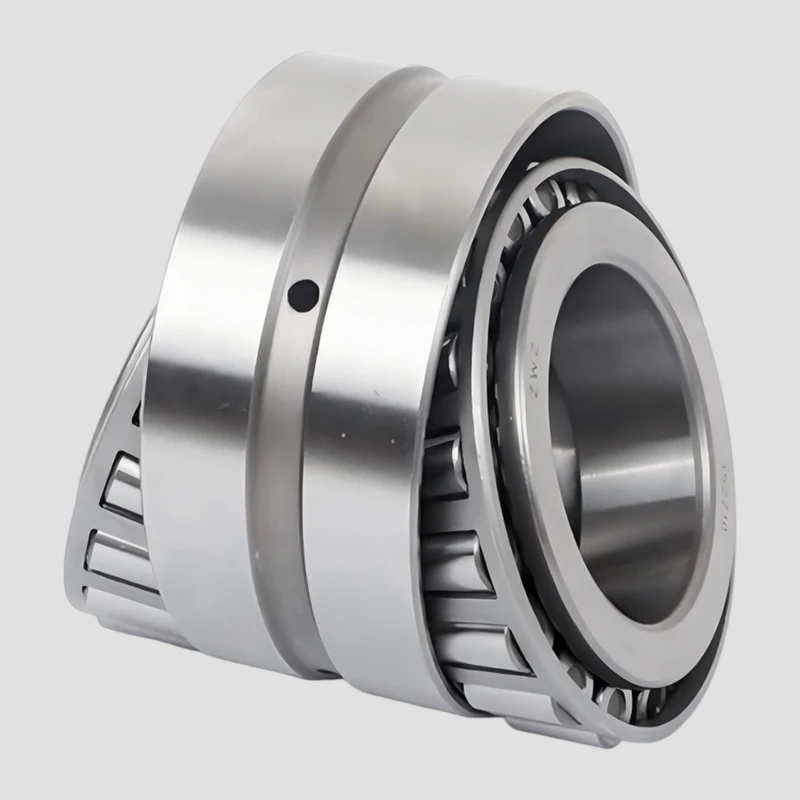
Double Row Angular Contact Slewing Bearings: Features two independent raceways with offset contact angles to handle higher overturning moments and reversing loads.
Crossed Roller Slewing Bearings: Cylindrical rollers arranged at right angles alternating in V-grooves; offers high rigidity and low rotational clearance under heavy radial-axial loads.
Triple Row Cylindrical Roller Slewing Bearings: Separated raceways allow independent load distribution across three rows of rollers, yielding maximum dynamic load capacity for ultra-heavy mining and marine equipment.
External-Toothed Six Row Cylindrical Roller Slewing Bearings: High-capacity multi-row roller assembly with external gear teeth tailored for extreme continuous-duty slewing drives.
Internal-Toothed Four Point Contact Slewing Bearings: Compact space-saving profile with internal gear integration, protecting the gear mesh zone from external environmental debris.
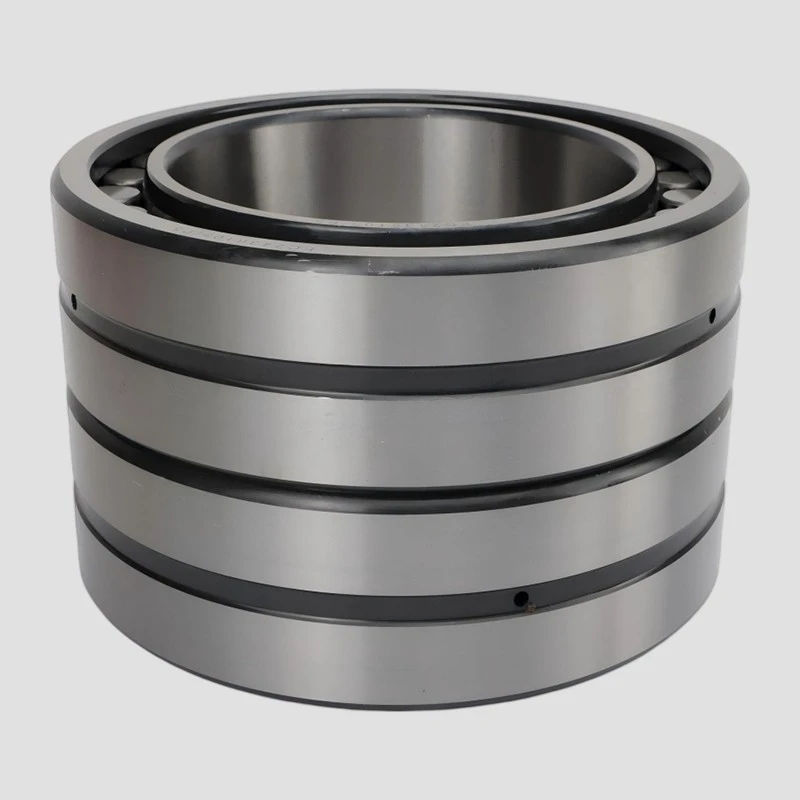
Material Composition: Forged rings manufactured from 42CrMo4 or C50E steel, vacuum-degassed to minimize non-metallic inclusions and ensure homogeneous microstructures.
Heat Treatment: Induction-hardened raceways achieving surface hardness of 55-62 HRC to a specified depth of 3-6 mm, maintaining a tough core structure to absorb impact shock loads.
Gear Hardening: Tooth flanks undergo induction hardening (50-55 HRC) to extend wear resistance and fatigue life under high torque transmission.
Sealing & Lubrication: Nitrile rubber (NBR) double-lip seals block moisture and abrasive dust ingress; equipped with radial grease nipples for periodic relubrication.
Internal Clearance: Controlled radial and axial internal clearance customized per operating temperature and load spectrum requirements.
Key Specifications
|
Bearing Type |
Outer Diameter Range (mm) |
Dynamic Axial Load (kN) |
Dynamic Radial Load (kN) |
Gear Type |
Typical Application |
|
Four Point Contact Ball |
200 - 5000 |
80 - 4500 |
50 - 2800 |
Internal / External |
Mobile Cranes |
|
Double Row Angular Contact |
400 - 4500 |
300 - 6000 |
180 - 3500 |
Internal / External |
Port Cranes |
|
Crossed Roller |
300 - 3000 |
250 - 5200 |
220 - 4800 |
Untoothed / Toothed |
Precision Index Tables |
|
Triple Row Roller |
800 - 6000 |
1200 - 18000 |
900 - 12000 |
External |
Excavator Shovels |
Load Calculation
Determine maximum axial force (Fa), radial force (Fr), and overturning moment (M) acting on the bearing center.
Safety Factor Application
Apply an operational safety factor based on dynamic load ratings and fatigue limits specified in ISO 281 standards.
Speed & Duty Cycle
Evaluate rotational velocity (RPM) and operational frequency. Roller designs suit low-speed, high-load conditions; ball designs accommodate moderate speeds.
Gear Selection
Calculate pitch circle diameter (PCD), module, and tooth number to match the output pinion of the slewing drive gearbox.
Mounting Space Envelope
Check bolt hole pitch, axial height, and clearance constraints within the equipment chassis.
Applications
Construction & Earthmoving
Excavators, tower cranes, truck-mounted cranes.
Renewable Energy
Yaw and pitch drives in wind turbine generators, solar trackers.
Marine & Offshore
Deck cranes, ship loaders, radar pedestals.
Industrial Automation
Heavy industrial rotary tables, ladle turrets, industrial manipulators.
Structural Rigidity: The mating structure (chassis and upper platform) must be flat and rigid to prevent localized stress concentrations; recommended mounting plate thickness is at least 1.5 times the bolt diameter.
Surface Flatness: Machining tolerance for mounting surface flatness should be within 0.05 mm to 0.2 mm depending on bearing diameter.
Bolt Specifications: Use grade 10.9 or 12.9 high-tensile socket head cap screws; tighten using a calibrated torque wrench in a criss-cross pattern. Do not reuse bolts after removal.
Gear Alignment: Ensure proper backlash (typically 0.03 x module) between the pinion and internal/external gear ring at the high-point mark (stamped on the unhardened plug zone).
Inspection & Quality Control
Forging Inspection
Ultrasonic testing (UT) performed on raw forgings per ASTM A388 to detect internal voids and cracks.
Dimensional Accuracy
Measured using laser trackers and coordinate measuring machines (CMM) to verify raceway diameter, pilot dimensions, and hole pitch.
Hardness Testing
Leeb and Rockwell hardness testers verify raceway quenching depth and gear flank hardness.
Runout Verification
Radial and axial runout checked on dedicated test benches prior to rust-preventative coating and packaging.
Supply & Customization Options
Custom Geometries
Non-standard bolt hole patterns, specialized gear modules, and mounting dimensions engineered to retrofit existing legacy equipment.
01
Material Variants
Stainless steel configurations or specialized corrosion-resistant coatings (e.g., zinc plating, Dacromet) for marine environments.
02
Special Lubricants
High-temperature, low-temperature, or food-grade greases supplied upon request.
03
Packaging
VCI anti-corrosion film wrapping secured inside export-grade fumigated wooden crates.
04
What Buyers Should Provide for Quotation
Exact application description and operating environment.
Load parameters: Axial load (Fa), radial load (Fr), and overturning moment (M).
Rotational speed (RPM) or oscillating angle and frequency.
Geometric constraints: Maximum outer diameter, minimum inner diameter, and allowable height.
Gear requirements: Internal teeth, external teeth, or gearless, along with required transmission ratio or pinion details.
Target quantity and annual delivery schedule.
FAQ
Q: What is the purpose of the soft plug on the slewing bearing raceway?
A: The soft plug marks the unhardened zone where the raceway induction hardening process begins and ends. It is drilled and plugged after rolling element insertion. Never position high-load zones directly over the soft plug location during installation.
Q: How often should slewing bearings be relubricated?
A: Relubrication intervals depend on operating load, speed, and environment. Standard industrial applications require grease replenishment every 100 to 200 operating hours. High-dust or continuous-rotation setups require more frequent greasing until fresh grease purges from the seals.
Q: What causes premature raceway spalling?
A: Premature spalling typically results from structural foundation deformation, insufficient lubrication, exceeding rated static/dynamic load limits, or improper bolt preload leading to uneven load distribution.
Q: How do internal and external gears affect design selection?
A: External-toothed bearings allow easier inspection of the gear mesh and easier maintenance of the drive pinion. Internal-toothed bearings enclose the gear ring within the bearing body, saving radial space and protecting the teeth from environmental contamination.
Q: What anti-corrosion protection is standard for export shipments?
A: Bearings are cleaned, coated with industrial rust-preventative oil, wrapped in VCI moisture-barrier film, and sealed in heavy-duty plywood crates suitable for long-term ocean freight.
Q: Can slewing bearings handle pure radial loads?
A: No. Slewing bearings are structurally engineered to handle combined loads (axial, radial, and moment). If pure radial loads predominate without significant axial loads or moments, standard radial roller or spherical roller bearings are more appropriate.

RFQ
Submit your technical specifications, application parameters, or drawings to our engineering team for load calculation, model selection, and commercial quotation.
Email: inquiry@bearingexample.com
Required Data: Load values (Fa, Fr, M), outer diameter limit, gear configuration, and estimated annual volume.
As one of the most professional slewing bearings manufacturers and suppliers in China, we also support customized service. Please feel free to wholesale durable slewing bearings made in China here and get pricelist from our factory. For price consultation, contact us.