


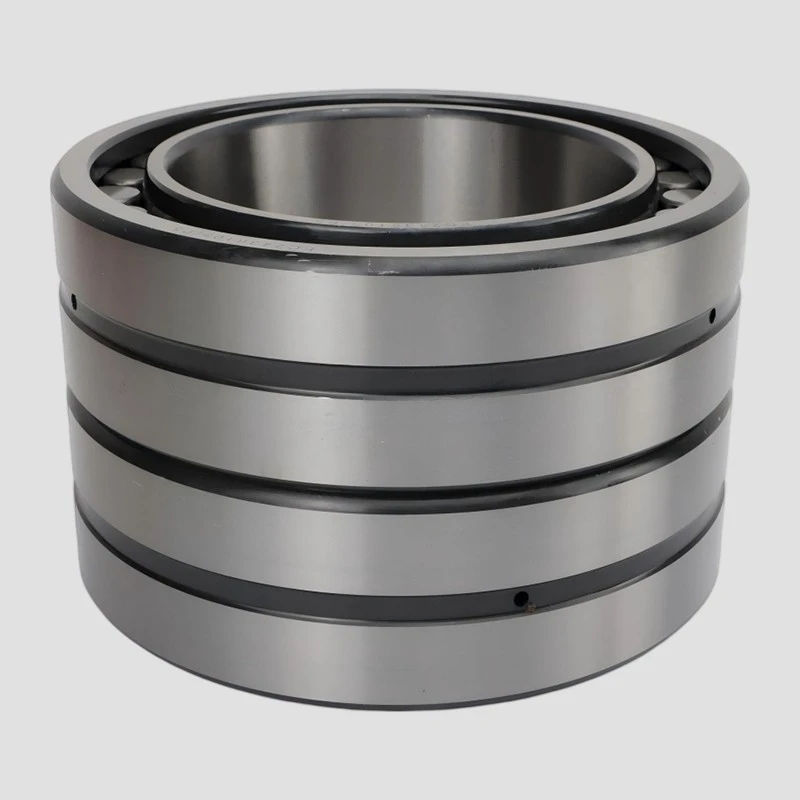
Product Overview
External-toothed six-row cylindrical roller slewing bearings are engineered for ultra-heavy industrial machinery requiring extreme load-carrying capacity and high rigidity. By arranging six independent rows of cylindrical rollers in orthogonal and parallel raceways, this bearing architecture distributes massive radial loads, axial forces, and overturning moments simultaneously across multiple contact points. It serves as the core rotational interface in heavy-load, low-speed equipment operating under harsh environments.
Bearing Structure
Raceway Configuration: Comprises four outer and inner retaining rings with six distinct raceway paths, housing alternating horizontal and vertical cylindrical rollers.
Roller Arrangement: Two rows of rollers bear axial loads acting in opposite directions; four rows of rollers handle radial forces and guide the precise alignment of the main assembly.
Gear Geometry: Features an integrated external gear rim directly cut into the outer or inner ring, optimized for peripheral pinion engagement.
Cages and Spacers: Equipped with solid brass or high-strength polyamide segment spacers to prevent roller skewing and minimize friction under heavy preload.
Sealing System: Double-lip NBR or FKM contact seals fitted on both sides to retain lithium-complex grease and exclude ingress of abrasive dust, scale, and moisture.
Key Product Characteristics
Massive Load Distribution: Six parallel load-transfer zones drastically reduce Hertzian contact stress per roller compared to single- or triple-row designs.
Zero Radial Play under Preload: Precision-adjusted internal clearance eliminates radial and axial runout, guaranteeing structural stability under dynamic overturning moments.
High Gear Tooth Bending Fatigue Strength: Induction-hardened gear flanks (tooth hardness 50-58 HRC) provide high resistance to tooth breakage and pitting under high-torque transmission.
Rigid Section Profile: Thickened forged ring sections prevent housing deformation under localized structural stress.
Key Specifications
|
Parameter / Specification |
Technical Value / Range |
|
Inner Diameter (d) |
800 mm - 5,000 mm |
|
Outer Diameter (D) |
1,100 mm - 6,000 mm |
|
Overall Height (H) |
150 mm - 600 mm |
|
Roller Count / Rows |
6 Rows Cylindrical Rollers |
|
Material Grade |
42CrMo4 (Forged Alloy Steel) / 50Mn |
|
Raceway Hardness |
Induction Hardened, 55-62 HRC |
|
Gear Tooth Hardness |
Induction Hardened, 50-58 HRC |
|
Lubrication Type |
EP2 Lithium Complex Grease with MoS2 |
|
Precision Grade |
ISO Class P5 / P6 |
Toothless / Internal-Toothed / External-Toothed Options
External-Toothed Type: The gear teeth are cut on the outer circumference of the ring. This configuration allows the driving pinion to be mounted externally, simplifying gearbox integration and providing a larger pitch circle diameter for higher torque transmission capacity.
Internal-Toothed Type: Gear teeth are cut on the inner circumference, protecting the meshing zone from external contaminants.
Toothless Type: Ungeared variant relying on friction clamping or external drive mechanisms for rotation.
Load & Operating Considerations
Load Limits: Designed for combined loads where axial force and overturning moment dominate. Ensure safety factors (s >= 1.5) for static load ratings.
Speed Range: Suitable for intermittent, low-speed rotation (n < 10 rpm). High peripheral speeds generate excessive roller friction and heat.
Mounting Structure Rigidity: Requires a machined, flat mounting structure (flatness tolerance within 0.05 mm to 0.15 mm depending on diameter) to prevent ring distortion and uneven load distribution across the six roller rows.
Relubrication Interval: Integrated grease nipples require periodic re-greasing every 100 to 200 operational hours depending on dust levels and load cycles.
Applications
Heavy-Duty Cranes: Port cranes, floating cranes, and heavy crawler cranes subjected to extreme dynamic tipping moments.
Metallurgical Equipment: Reclaimers, stackers, ladle turrets, and large converters in steel mills.
Tunnelling & Mining: Shield tunneling machines (TBM cutterheads) and large bucket wheel excavators.
Marine Engineering: Offshore drilling platforms and heavy-lift vessel deck cranes.
Mounting & Installation
Foundation Check: Verify mounting surface flatness using laser leveling instruments; eliminate burrs, paint, or rust.
Lifting & Handling: Use multi-point sling lifting via designated lifting holes; avoid impact shock to the gear teeth and seals.
Gear Radial Runout Alignment: Align the soft zone (marked with a green paint spot on the raceway) at the zone of minimum load, and align the tooth runout high point (marked with green paint on the gear) with the mating pinion.
Bolt Tightening: Fasten high-strength grade 10.9 or 12.9 mounting bolts in a criss-cross sequence using a calibrated hydraulic torque wrench. Apply thread-locking compound as specified.
Inspection & Quality Control
Raw Material Testing: Ultrasonic testing (UT) of forged rings in accordance with ASTM A388 to detect internal inclusions or micro-cracks.
Dimensional Metrology: Coordinate measuring machines (CMM) and laser track measurement for raceway diameters, height tolerances, and mounting hole pitch circles.
Metallurgical Inspection: Leeb hardness testing on induction-hardened raceways and gear teeth; metallographic evaluation for case depth (5 mm - 8 mm).
Runout Verification: 100% factory inspection of axial and radial runout under loaded simulation.
Supply Options
Customization: Tailored mounting hole patterns, special gear modules, and corrosion-resistant coatings (zinc plating or cadmium-free alternatives) available upon request.
Packaging: Export-standard fumigated wooden crates with internal moisture-barrier VCI foil wrapping and rigid steel support brackets to prevent transit distortion.
Lead Time: Standard configurations ship within 4-6 weeks; custom engineered variants quoted per drawing review.
FAQ
Q: How does a six-row cylindrical roller design differ from a triple-row roller design in load handling?
A: A six-row configuration doubles the load-bearing contact points across independent orthogonal paths, distributing high overturning moments and heavy axial forces more evenly, which reduces localized deformation under peak shock loads.
Q: What is the significance of the soft zone on the raceway ring?
A: The soft zone (marked with a paint spot) indicates the through-hardening termination point of the raceway induction hardening process. It must be positioned in the non-loaded or minimum-load zone of the application structure.
Q: Can these bearings be supplied with pre-loaded pinion gears?
A: Yes, matched mating pinions with corresponding heat treatment and tooth profile corrections can be supplied upon request to ensure optimal mesh performance.
Q: What documentation is provided with each shipment?
A: Each delivery includes material test certificates (EN 10204 3.1), dimensional inspection reports, hardness test logs, and comprehensive installation manuals.
Hot Tags: external-toothed six row cylindrical roller slewing bearings, China external-toothed six row cylindrical roller slewing bearings manufacturers, suppliers, factory